
TL;DR

Get beauty and skincare favorites delivered free — and shop member deals
- Fast, free delivery on millions of items
- Access to Prime Big Deal Days deals on October 6–7
- Prime Video, Amazon Music and more included
Wavelength determines how deep light penetrates and which skin issues it targets, while power density controls the dose of light delivered. Balancing both is key for effective LED therapy. Proper settings improve outcomes and safety.
Imagine a gentle cascade of light, each hue vibrating at a different depth, whispering to your skin’s cells. LED therapy isn’t just about shining bright; it’s a science of precision. The secret lies in two key elements: wavelength and power density. When used thoughtfully, they unlock better skin renewal, faster healing, and more noticeable glow.
But what exactly makes a particular combination effective? How do these parameters influence your results? In this guide, you’ll learn how to decode the technical language into practical insights, so you can choose treatments that truly work for your skin’s unique needs.
Matching wavelength to your skin issue increases treatment effectiveness—blue for bacteria, red for collagen, NIR for deep tissue.
Optimal power density lies generally between 4 and 20 J/cm²; exceeding this risks side effects without added benefits.
Modern devices with adjustable settings allow personalized protocols, boosting results while maintaining safety.
Consistency over weeks, with sessions of 10-30 minutes, is key to visible improvements.
Always follow manufacturer instructions and consider professional advice to avoid overexposure.
Why Wavelength Matters More Than You Think
Wavelength is the color of light, measured in nanometers (nm). It determines how deeply the light penetrates and which skin layers it influences. For example, blue light at around 415 nm targets bacteria on the surface, making it ideal for acne. Red light at 630-700 nm stimulates collagen, easing fine lines and wrinkles. Near-infrared (NIR) wavelengths—around 800-900 nm—reach deeper tissues, supporting healing and pain relief.
Think of wavelength as a map guiding light to the right neighborhood. A shorter wavelength like blue stays near the surface, while longer wavelengths like NIR go deep into tissues. Choosing the right wavelength is like selecting the perfect key to unlock your skin’s potential.
Understanding why certain wavelengths target specific skin issues matters because it allows you to customize your treatment. For example, improper wavelength choice might mean your light therapy isn’t reaching the problem areas effectively. This misalignment can result in longer treatment times or suboptimal outcomes. Conversely, selecting the right wavelength ensures your skin receives the precise signals needed for regeneration or healing, making each session more efficient and effective.
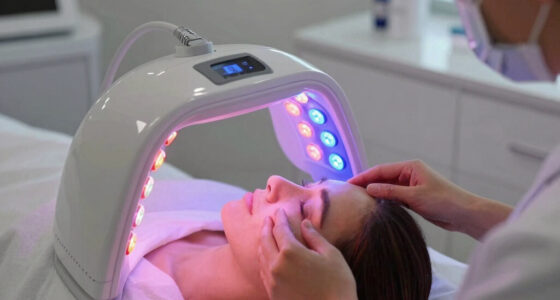
LED light therapy mask adjustable settings
As an affiliate, we earn on qualifying purchases.
As an affiliate, we earn on qualifying purchases.
How Power Density Shapes Your Results
Power density, or fluence, is how much light energy your skin absorbs during treatment, measured in J/cm². It’s akin to dosing medication: too little, and your skin might not respond; too much, and you risk irritation or damage. The balance is delicate because each skin condition and individual skin sensitivity requires a tailored dose. For example, sensitive skin or active inflammation might need lower doses, while thicker or stubborn skin issues could benefit from higher doses within safe limits.
Imagine watering delicate seedlings: a gentle sprinkle promotes growth, but overwatering can drown them. Similarly, an optimal power density stimulates cellular activity and collagen production without overwhelming the skin. If the dose is too low, the treatment might be ineffective; if too high, it could cause redness, irritation, or even micro-injuries, setting back progress. Therefore, understanding and adjusting power density is crucial for maximizing benefits while minimizing risks.
Research shows that increasing power density can enhance treatment outcomes up to a certain threshold. Beyond this point, additional energy doesn’t translate into better results and can cause adverse effects. This tradeoff highlights the importance of precise calibration—using just enough energy to stimulate healing without crossing into harmful territory. Properly managed, power density ensures your skin responds positively, healing faster and achieving better results over fewer sessions.
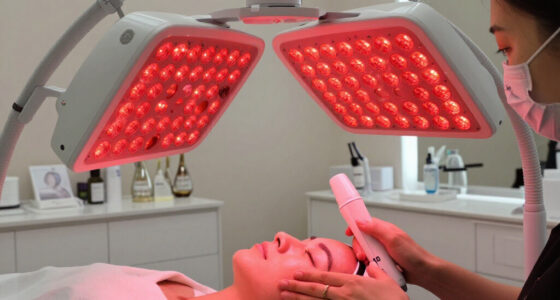
red blue near-infrared LED skin treatment device
As an affiliate, we earn on qualifying purchases.
As an affiliate, we earn on qualifying purchases.
The Perfect Match: Combining Wavelength and Power Density
Think of wavelength and power density as a duet—each must harmonize for the best performance. For example, a red light at 660 nm paired with a power density of 10 J/cm² can effectively stimulate collagen and reduce wrinkles. Conversely, using a high power density with blue light may cause unnecessary irritation without added benefit.
To visualize this, consider a comparison table:
| Parameter | Low Setting | Optimal Setting | Too High |
|---|---|---|---|
| Wavelength | Blue (415 nm) | Red (660 nm) | Near-Infrared (900 nm) |
| Power Density | 2 J/cm² | 10 J/cm² | 30 J/cm² |
This balance ensures the light penetrates effectively without risking overheating or diminishing returns. It’s about matching the right dose with the right target. For example, using the correct combination can mean the difference between a session that rejuvenates your skin and one that causes irritation or delays healing. The synergy between wavelength and power density determines how well your skin absorbs the light and responds, making this pairing crucial for effective treatment.
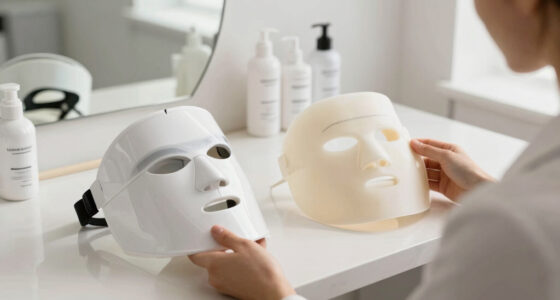
professional LED facial mask for skin rejuvenation
As an affiliate, we earn on qualifying purchases.
As an affiliate, we earn on qualifying purchases.
Real-World Tips to Maximize Your LED Results
Here’s how you can get the most from your LED mask:
- Choose a device with adjustable wavelengths and power settings to tailor treatments precisely.
- Start with lower power densities—around 4-6 J/cm²—and gradually increase if tolerated, to avoid overloading your skin’s capacity to heal.
- Use treatments consistently—most protocols recommend 3-4 sessions per week for 4-8 weeks—to build cumulative benefits.
- Keep sessions within 10-30 minutes, depending on device instructions, to prevent overstimulation or overheating.
- Always follow safety guidelines—avoid overexposure and monitor skin reactions to prevent adverse effects.
For example, if you’re targeting fine lines, start with red light at 660 nm and 6 J/cm². Observe how your skin responds, and if it tolerates the treatment well, you can gradually increase the dose or frequency. Consistency and careful adjustment are key to making LED therapy work effectively for your skin’s unique needs.
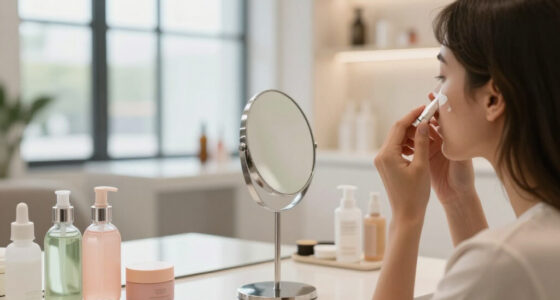
home LED therapy device for acne and anti-aging
As an affiliate, we earn on qualifying purchases.
As an affiliate, we earn on qualifying purchases.
Watch Out: When Settings Go Wrong
Incorrect wavelength or excessive power density can diminish results or cause irritation. For instance, using near-infrared wavelengths at very high power densities might lead to overheating, redness, or discomfort, especially if your skin isn’t prepared for such intensity. Similarly, applying blue light at a very high dose can dry out the skin or cause peeling, which hampers healing and may lead to longer recovery times.
A practical tip: always follow manufacturer guidelines and consult professionals when unsure. Recognizing that more isn’t always better is crucial—overdoing it can undo your progress. Properly calibrated settings ensure your skin benefits from the therapy without unnecessary side effects. Patience combined with precise application maximizes your chances of achieving the desired results safely.
Frequently Asked Questions
How do I know which wavelength is best for my skin concerns?
Identify your primary skin goal—acne, anti-aging, deep healing—and select the wavelength that targets that issue. Blue (415 nm) for bacteria, red (660 nm) for collagen, near-infrared (800+ nm) for deeper tissues.Can I use a higher power density for faster results?
Not always. Higher doses can cause irritation or damage. Stick to manufacturer guidelines or professional advice, and increase gradually if tolerated.How long before I see results with LED masks?
Most users notice improvements after 4-8 weekly sessions. Visible changes in skin texture and tone often appear after 2-3 months of consistent use.Are there risks with incorrect settings?
Yes. Overexposure at high power densities or inappropriate wavelengths can cause redness, irritation, or damage. Always follow safety instructions.Conclusion
Balancing wavelength and power density isn’t just technical jargon; it’s the secret to smarter, safer LED treatments. Think of it as tuning a instrument—when perfectly calibrated, your skin responds beautifully.
Next time you choose an LED mask, pay attention to these settings. Your skin’s glow depends on it—like a fine Italian espresso, the right dose makes all the difference.
Evergreen bestsellers Picks
bestsellers
As an affiliate, we earn on qualifying purchases.