
TL;DR
Prime for Young Adults — start your free trial
Fast free delivery, streaming and member deals for eligible 18–24 year olds.
Try it freeAs an affiliate, we earn on qualifying purchases.
Most at-home beauty devices are FDA-cleared, not approved. Clearance signals safety, not proven effectiveness. Verifying a device’s 510(k) number is key to trusting its safety claims.
When you shop for an at-home beauty device, the FDA status can seem like a confusing maze of labels and claims. But understanding what those labels really mean changes everything. It’s the difference between a product that’s been reviewed for safety and one that’s simply registered or marketed without oversight.
Knowing whether a device is FDA-cleared, approved, or just registered influences your confidence—and your safety. This guide breaks down the distinctions, showing you how to spot what’s trustworthy and what’s just marketing fluff. Because in the world of beauty tech, being informed is your best tool.
Most at-home beauty devices are FDA-cleared, not approved, meaning they meet safety standards but not proven effectiveness.
Always verify a device’s K-number in the FDA database to confirm its clearance status and intended use.
Beware of vague claims like ‘FDA technology’—these often mean little without specific clearance details.
Devices that skip FDA review aren’t automatically unsafe, but they require extra scrutiny of marketing and safety warnings.
Understanding the difference between clearance and approval helps you choose devices that are both safe and suited to your goals.
How FDA Status Influences Your Confidence in At-Home Beauty Devices
Most at-home beauty devices are FDA-cleared, not approved — and that single word changes everything. Clearance signals a device was reviewed for safety, not that it’s proven to work. Learning to read the label — cleared, approved, or merely registered — is the difference between real oversight and marketing fluff.
“Clearance is a safety badge — not a promise of results. The K-number is what turns a vague claim into a verifiable fact.”
Cleared vs. Approved vs. Registered — three very different words
Brands blur these terms on purpose. “Registered” is paperwork — like registering a bike with the city, no review involved. “Cleared” means substantially equivalent to something already on the market. “Approved” is reserved for high-risk devices and almost never applies to beauty tech.
| Dimension | FDA Cleared ★ | FDA Approved | FDA Registered |
|---|---|---|---|
| Pathway | 510(k) premarket notification | Premarket Approval (PMA) | Administrative facility listing |
| Review depth | ~ Substantial equivalence to a predicate device | ✓ Rigorous clinical trials required | ✗ None — no product review at all |
| Proves effectiveness | ~ Not by itself — confirms safety standards | ✓ Yes, for defined high-risk uses | ✗ No — meaningless as a trust signal |
| Typical in beauty tech | ✓ Most LED masks, microcurrent, IPL devices | ✗ Almost none — claims are usually exaggerated | ~ Common as marketing filler |
| Trust signal | ✓ Strong — for safety, not superiority | ✓ Very strong — but vanishingly rare | ✗ Weak to none — a red flag when sold as one |
What earns your confidence — and what should kill it
Clearance is indication-specific: a 510(k) covers one defined intended use, not every claim on the box. Trust the verifiable, question the vague.
Devices that skip FDA review — positioned as “cosmetic” or “general wellness” — aren’t automatically unsafe. But with no government assessment behind them, the burden of proof shifts onto you: scrutinize the marketing language and demand verified data.
- A verifiable 510(k) K-number printed on the device, box, or manual
- Clearance that covers the specific claim — e.g. wrinkle reduction, not just “light therapy”
- Published clinical data supporting the marketed benefit
- Transparent contraindications — especially for dark skin tones and sensitive eyes
- “FDA approved” language on a consumer skincare gadget
- “FDA registered” presented as a selling point or safety stamp
- Vague phrases like “FDA technology” with no clearance details
- No listed warnings or contraindications anywhere in the materials
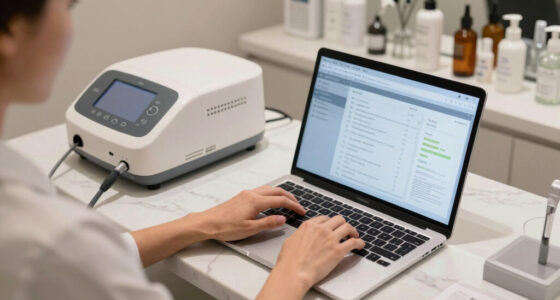
How to verify a device — five steps, two minutes
This process turns a vague marketing claim into a concrete safety check. No K-number, no confidence.
Find the K-number
Look on the device itself, the packaging, or inside the user manual.
Open the FDA database
Go to the FDA’s 510(k) Premarket Notification database online.
Search the number
Enter the K-number or brand name to pull up the clearance record.
Match the claim
Confirm the clearance covers the exact benefit being advertised.
Read the warnings
Review contraindications — critical for dark skin or sensitive eyes.
A red-light therapy mask claiming to reduce wrinkles should have a clear 510(k) number linked to a predicate for wrinkle reduction — not merely a facility registration or a clearance for a different indication.
Where your device typically sits on the oversight spectrum
Illustrative share of marketed devices with verifiable 510(k) clearance, by category — from well-covered light therapy to the microneedling gray zone and unreviewed “wellness” gadgets.
From marketing claim to real confidence
Every trustworthy device can walk this full chain. If a link breaks — no number, mismatched use, missing warnings — your confidence should break with it.
Marketing Claim
“Reduces wrinkles”
K-Number
Verifiable 510(k)
Intended Use
Matches the claim
Warnings
Contraindications read
Confidence
Earned, not assumed
What’s the real meaning behind FDA clearance and approval?
FDA clearance isn’t the same as approval. Clearance, primarily via the 510(k) process, means the device is ‘substantially equivalent’ to something already on the market. It signals safety and that the device meets basic standards—nothing more.
Approval, on the other hand, is reserved for high-risk devices like pacemakers—requiring rigorous clinical trials. Almost no at-home beauty device has this status. Brands claiming FDA approval for their skincare gadgets often confuse or exaggerate, because most devices are only cleared.
Meanwhile, ‘FDA registered’ is just an administrative step, not a safety or efficacy stamp. It’s like registering your bike with the city—no review or safety check involved.
FDA cleared at-home beauty devices
As an affiliate, we earn on qualifying purchases.
As an affiliate, we earn on qualifying purchases.
How to verify if your device is FDA cleared—step by step
- Identify the device’s K-number—usually printed on the device, packaging, or in the user manual.
- Visit the FDA’s 510(k) Premarket Notification database online.
- Enter the K-number or brand name to find the device’s clearance details.
- Check if the clearance covers the specific benefit or claim the device makes.
- Review any warnings or contraindications listed—especially if you have dark skin or sensitive eyes.
For example, a red light therapy mask claiming to reduce wrinkles should have a clear 510(k) number linked to a predicate for wrinkle reduction. This verification process turns a vague claim into a concrete safety check.
FDA 510(k) approved skincare tools
As an affiliate, we earn on qualifying purchases.
As an affiliate, we earn on qualifying purchases.
Why many devices skip FDA review—and what it means for you
Many at-home devices avoid FDA review by classifying themselves as ‘cosmetic’ or ‘general wellness.’ These products often include massage tools, scalp stimulators, or simple skincare gadgets. They are legally exempt from premarket review because they pose minimal risk.
While skipping review doesn’t automatically mean danger, it shifts responsibility onto you. Without FDA scrutiny, claims about effectiveness or safety aren’t backed by a government assessment. That’s why it’s vital to scrutinize marketing language and look for verified data.
For example, an LED mask marketed as ‘FDA technology’ might only have a facility registration, not a clearance for wrinkle treatment. Knowing this helps you stay alert to true safety signals.
at-home laser hair removal device with K-number
As an affiliate, we earn on qualifying purchases.
As an affiliate, we earn on qualifying purchases.
How FDA status influences your confidence—and what to look for
FDA clearance acts as a safety badge, showing the device has passed basic safety benchmarks. It’s the heart of trust in the at-home beauty world. But it’s not a guarantee that the device will deliver results.
Look for a verifiable 510(k) number, specific to the claim you’re interested in. Check whether the device’s intended use matches your goals—whether for acne, wrinkles, or hair removal. Read the contraindications, especially if you have darker skin or sensitive eyes.
For example, a laser hair removal device with a clear 510(k) for IPL hair reduction provides confidence—but only if it’s used correctly and within safety guidelines.
FDA safety verified beauty gadgets
As an affiliate, we earn on qualifying purchases.
As an affiliate, we earn on qualifying purchases.
Common questions about FDA status—answered plainly
- Q: Does FDA clearance mean the device works?
A: Not necessarily. Clearance confirms safety and equivalence, but effectiveness depends on the device and proper use. - Q: How can I check if my device is FDA cleared?
A: Find the K-number on the device or packaging, then look it up in the FDA’s database online. - Q: Are devices without FDA clearance dangerous?
A: Not automatically. But absence of clearance means less government oversight—do your homework before buying. - Q: Why do some popular devices have no FDA status?
A: Because they’re considered low-risk or classified as cosmetics, so they aren’t reviewed premarket. - Q: Is FDA approval better than clearance?
A: Yes, but very few consumer devices seek approval, which involves more rigorous testing for high-risk products.
Conclusion
Knowing the true meaning behind FDA labels empowers you to make smarter choices in the crowded world of at-home beauty tech. It’s about reading the fine print, verifying claims, and trusting what’s backed by real oversight.
Next time you consider a new gadget, ask: Does it have a verifiable 510(k)? Is the intended use clear? Your skin—and peace of mind—will thank you.
Fall yard work Picks
leaf blowers
As an affiliate, we earn on qualifying purchases.