
TL;DR
Prime for Young Adults — start your free trial
Fast free delivery, streaming and member deals for eligible 18–24 year olds.
Try it freeAs an affiliate, we earn on qualifying purchases.
FDA clearance confirms a device has been reviewed for safety and effectiveness by the FDA, crucial for medical claims. Certifications like ISO show quality standards but aren’t substitutes. Always verify a device’s FDA status before trusting its health claims.
When you buy an at-home health device—whether a blood pressure monitor or a skin laser—you want it to be safe and reliable. But how do you know if it truly meets those standards? That’s where the difference between FDA clearance and medical certification becomes crucial.
Understanding what each label or approval means helps you avoid low-quality products and ensures you’re using devices that are safe for your health routine. In this guide, you’ll learn how the FDA’s review process compares to third-party certifications and what that means for your confidence in at-home devices.
FDA clearance confirms a device has been reviewed for safety and effectiveness for medical claims in the U.S.
Third-party certifications, like ISO or CE, indicate quality standards but do not replace FDA approval.
Always verify a device’s FDA status—look it up on the official FDA database or check for official labeling.
Not all at-home devices need FDA clearance—cosmetic or wellness tools often fall outside regulatory scope.
Prioritize FDA-cleared devices for health-related monitoring or treatment to reduce safety risks.
FDA Clearance vs. Medical Certification
When a device measures, diagnoses, or treats, the label matters. FDA clearance addresses a device’s specific medical use in the United States. ISO and other third-party credentials can show strong quality processes, but they do not replace the applicable FDA review.
Three signals that answer different questions
A credible-looking badge may tell you something useful, but it may not answer the question that matters most: has this exact device been reviewed for the health claim being made?
FDA clearance
Commonly refers to a 510(k) decision showing that a device is substantially equivalent to a legally marketed predicate for its stated intended use. It is not identical to FDA approval.
ISO certification
May demonstrate that a manufacturer follows audited quality-management practices. It supports process confidence, but does not independently establish U.S. authorization for a device’s medical claims.
CE marking
Signals conformity with applicable European requirements. Its meaning depends on the product and regulatory route, and it does not replace FDA requirements for marketing a medical device in the U.S.
What each designation can—and cannot—tell you
Treat FDA status and third-party certification as complementary evidence, not interchangeable seals.
| Decision factor | FDA clearance | Third-party certification |
|---|---|---|
| Primary focus | ✓Specific device, intended use, risk controls, and applicable performance evidence | ~Defined quality, manufacturing, electrical, or safety standard |
| Authority | ✓U.S. Food and Drug Administration | ~Standards bodies, notified bodies, testing laboratories, or certifiers |
| Medical claims in the U.S. | ✓May provide the required marketing authorization for the stated use | ✗Does not substitute for applicable FDA authorization |
| Manufacturing confidence | ~Regulatory controls apply, depending on device classification and pathway | ✓Can provide targeted evidence of an audited quality system |
| Proof every claim is true | ✗Only the cleared or approved intended use and labeling are relevant | ✗Certification scope may not cover clinical performance or advertised benefits |
| Consumer takeaway | ✓Match the database record to the exact model and health claim | ~Read the certificate scope, issuer, standard, and validity |
Important: FDA clearance, De Novo authorization, and FDA approval are distinct pathways. “FDA registered” or “FDA listed” alone does not mean a product is cleared or approved.
The claim determines the lane
The same-looking gadget can face different oversight depending on how it is intended and marketed. A step counter and an arrhythmia detector do not make the same promise.
General wellness
Products limited to healthy-lifestyle or low-risk wellness functions may fall outside premarket review requirements. Claims should avoid diagnosing, preventing, or treating disease.
Medical purpose
A device intended to diagnose, monitor, prevent, or treat a condition may require 510(k) clearance, De Novo authorization, PMA approval, or another applicable pathway.
Start with what the product promises
Classification depends on intended use, claims, risk, and applicable exemptions—not simply whether the product is used at home.
Does it influence a health decision?
If a reading may change medication, trigger emergency action, guide treatment, or reassure you that nothing is wrong, regulatory status and accuracy matter substantially.
Check the precise model and intended use. A cleared product family name does not automatically cover every version, feature, accessory, or advertised claim.
A five-point verification routine
Marketing language is easy to copy. Traceable regulatory information is harder to fake and easier to verify.
From marketing claim to confident use
A trustworthy purchase decision links every claim back to a defined product, regulatory record, supported use, and clear operating instructions.
Prioritize appropriate FDA authorization for devices that diagnose, monitor, or treat. Use ISO, CE, and other certifications as additional quality evidence—not as substitutes. Lack of clearance does not automatically mean unsafe, but it does mean you should determine whether review was required and whether the product’s health claims are supported.
What Is FDA Clearance and Why Should You Care?
FDA clearance is a formal process that demonstrates a device has been reviewed by the U.S. Food and Drug Administration and deemed safe and effective for its specific intended use. This process involves rigorous evaluation of safety data, performance claims, and manufacturing practices, ensuring that the device meets strict standards before it reaches consumers. For example, a home-use blood glucose monitor like the Accu-Chek Guide must undergo this process, providing reassurance that it reliably measures blood sugar levels and is safe for daily use.
This clearance isn’t just a bureaucratic checkbox; it directly impacts your health and safety. Devices that claim to diagnose, monitor, or treat health conditions must be evaluated thoroughly because incorrect readings or unsafe devices can lead to misdiagnosis or health risks. When a device is FDA-cleared, it signals that the manufacturer has met these high standards, reducing the likelihood of malfunctions or safety issues that could harm users. Think of it as a quality seal that indicates the device has passed a comprehensive safety and efficacy review, which is especially vital when your health depends on accurate information and safe operation.
FDA cleared blood pressure monitor
As an affiliate, we earn on qualifying purchases.
As an affiliate, we earn on qualifying purchases.
How Does Medical Certification Differ from FDA Clearance?
Medical certification often involves third-party organizations establishing standards for quality, safety, or manufacturing practices, such as ISO 13485 or CE marking. These certifications indicate that the device has been produced according to recognized quality management systems or safety standards, which can be a mark of reliability. However, they do not involve a direct review of the device’s safety or effectiveness in the context of medical claims by regulatory authorities like the FDA.
For instance, a device with ISO 13485 certification demonstrates that the manufacturer follows rigorous quality management practices, including consistent manufacturing processes and risk management. Yet, this certification does not mean the device has been evaluated for safety or efficacy in the U.S. market. Similarly, a CE mark indicates compliance with European standards but does not necessarily meet U.S. regulatory requirements.
Think of these certifications as a badge of quality or adherence to best practices—they suggest the device is well-made but do not guarantee it is safe or effective for medical purposes in the U.S. context. This distinction is critical because relying solely on third-party certs without FDA clearance could expose you to products that haven’t been thoroughly evaluated for safety or accuracy, especially for health-related functions.
medical certified skin laser device
As an affiliate, we earn on qualifying purchases.
As an affiliate, we earn on qualifying purchases.
Comparing FDA Clearance and Certifications Side-by-Side
| Feature | FDA Clearance | Third-Party Certification |
|---|---|---|
| What it verifies | Safety and effectiveness for medical claims, including diagnostic accuracy and risk mitigation | Adherence to quality standards, manufacturing practices, or safety protocols, such as ISO or CE compliance |
| Regulatory authority | U.S. Food and Drug Administration | External organizations like ISO, CE agencies, or proprietary certifiers |
| Legal requirement | Often required for devices making medical claims, especially for diagnosis or treatment | Not legally required but enhances credibility and quality perception |
| Example | Blood pressure monitors, glucose meters, pulse oximeters | ISO 13485 certification, CE mark on cosmetic or wellness devices |
| Guarantee of safety | Yes, after thorough review and testing | Indicative of quality, but no guarantee of safety or efficacy for medical claims |
FDA approved at-home health device
As an affiliate, we earn on qualifying purchases.
As an affiliate, we earn on qualifying purchases.
Do You Need FDA Clearance for Your At-Home Device?
Not all at-home devices require FDA clearance. Devices designed for fitness, wellness, or cosmetic purposes often fall outside the FDA’s regulatory scope because they do not make claims related to diagnosing, monitoring, or treating health conditions. For example, a fitness tracker that counts steps or a skincare device marketed solely for cosmetic improvements typically does not need FDA approval.
However, if a device claims to diagnose, monitor, or treat health conditions—such as a pulse oximeter measuring blood oxygen levels or a laser hair removal device claiming permanent results—it likely falls under FDA regulation and requires clearance. This is because such devices could directly impact health outcomes, and unverified claims or unsafe products could pose serious risks. Always verify the device’s labeling and consult FDA resources to confirm whether clearance is necessary. Checking the FDA database for the device’s registration or clearance status is a prudent step that can prevent potential safety issues or legal complications before purchase.
certified medical device for home use
As an affiliate, we earn on qualifying purchases.
As an affiliate, we earn on qualifying purchases.
Why Does FDA Clearance Matter for Your Home Health Devices?
FDA clearance is a critical safeguard because it signifies that a device has undergone rigorous review for safety, accuracy, and reliability. When a device is FDA-cleared, it has been tested against strict standards, reducing the risk of malfunctions or inaccuracies that could harm users or lead to misdiagnosis. For example, an FDA-cleared infrared therapy device for pain relief has been evaluated for safe thermal output and consistent performance, minimizing the risk of burns or ineffective treatment.
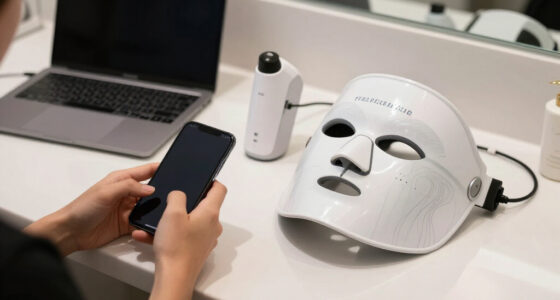
Furthermore, FDA clearance influences your confidence in the device’s claims. Without it, a device might promise benefits that are exaggerated or unsubstantiated, putting your health at unnecessary risk. Consider the case of at-home LED masks marketed for skin clearing; if they lack FDA clearance, their safety and efficacy are unverified, and using them might lead to skin irritation or ineffective results. Essentially, FDA clearance acts as a trusted stamp of safety and performance, giving you peace of mind that the device has been evaluated for real-world use. It’s especially important for devices that directly impact health, as unverified devices can cause harm or provide false reassurance.
What Should You Do Before Buying an At-Home Medical Device?
- Check the FDA database: Search the device name or manufacturer to confirm if it has been cleared or approved. This step is vital because it verifies the device’s legitimacy and safety claims.
- Read labels carefully: Look for the FDA logo, clearance or approval number, or statements indicating regulatory status. These indicators help you quickly identify whether the device has undergone official review.
- Research the manufacturer: Verify their reputation, history, and transparency regarding regulatory compliance. A reputable manufacturer is more likely to produce reliable, safe devices.
- Consider third-party certs: Certifications like ISO or CE can indicate adherence to quality standards, but remember they do not replace FDA clearance. Use them as supplementary indicators of quality.
- Consult a healthcare professional: For devices claiming health benefits or monitoring, ask your provider for advice. They can help you interpret claims and recommend safe options.
For example, a new laser device marketed online may seem appealing, but verifying its FDA clearance before purchase ensures you’re not risking safety or wasting money on an unverified product. Taking these steps minimizes the risk of buying ineffective or unsafe devices and helps you make informed decisions.
Frequently Asked Questions
Do all at-home health devices need FDA clearance?
No, only those that make medical claims—such as diagnosing, monitoring, or treating health conditions—must typically undergo FDA review. Devices marketed as wellness or cosmetic tools often don’t require clearance but should still be used with caution.
How can I verify if my device is FDA-cleared?
Visit the FDA’s official database and search for the device or manufacturer. Many devices also display the FDA logo or clearance number on their packaging or website. Verifying this information helps ensure that the device has been properly evaluated and approved for safe use.
What’s the main difference between FDA clearance and approval?
Clearance, via the 510(k) process, is for moderate-risk devices demonstrating substantial equivalence to existing products. Approval, via Premarket Approval (PMA), is for high-risk devices requiring more rigorous review. Clearance is more common for at-home devices because they generally pose lower risks.
Are third-party certifications enough to trust a device?
They indicate adherence to certain quality and safety standards, but they do not replace FDA clearance or approval. For health-related devices, always verify the FDA status to ensure the device has been properly evaluated for safety and efficacy.
Why should I care about FDA clearance when buying at-home devices?
FDA clearance provides assurance that the device has been evaluated for safety, accuracy, and performance, reducing the risk of harm or ineffective results. This is especially important for devices that monitor or treat health conditions, where unverified products could pose serious health risks.
Conclusion
Knowing whether an at-home device is FDA-cleared can mean the difference between safe, effective use and unnecessary risk. It’s a simple check that adds confidence—like reading a product label before trusting it with your health.
Next time you’re considering a new skincare laser or health monitor, pause to verify its regulatory status. Your health deserves that extra layer of assurance—because safety never goes out of style.
Flea & tick season Picks
flea and tick prevention
As an affiliate, we earn on qualifying purchases.