
TL;DR

Get beauty and skincare favorites delivered free with Prime
- Fast, free delivery on millions of items
- Prime Video, Amazon Music and more included
- Member-only deals all year
A Glamour UK guide featuring professional makeup artists outlines a sponge method for applying foundation: dispense a small amount onto the hand, place it with a brush, then tap it into the skin using a clean, slightly damp sponge. Artists say this approach helps blend thin layers; the result depends on the product and technique, and the guide does not establish that it lasts longer for everyone.
Glamour UK has published a foundation application guide in which professional makeup artists recommend using a clean, slightly damp sponge to tap foundation into the skin in thin layers. The report describes a four-step method and explains how artists use a brush to place product before blending with the sponge; the advice is practical technique, not evidence that the method works better for every person or guarantees all-day wear.
The guide recommends beginning with a few drops of foundation on the back of the hand, rather than applying it straight to the face. Tim Quinn, a New York-based celebrity makeup artist, says this makes it easier to control the amount used. Quinn then advises using a foundation brush to dot product onto the centre of the face, where many people want more coverage, and working outward. The guide favors liquid foundation for this method.
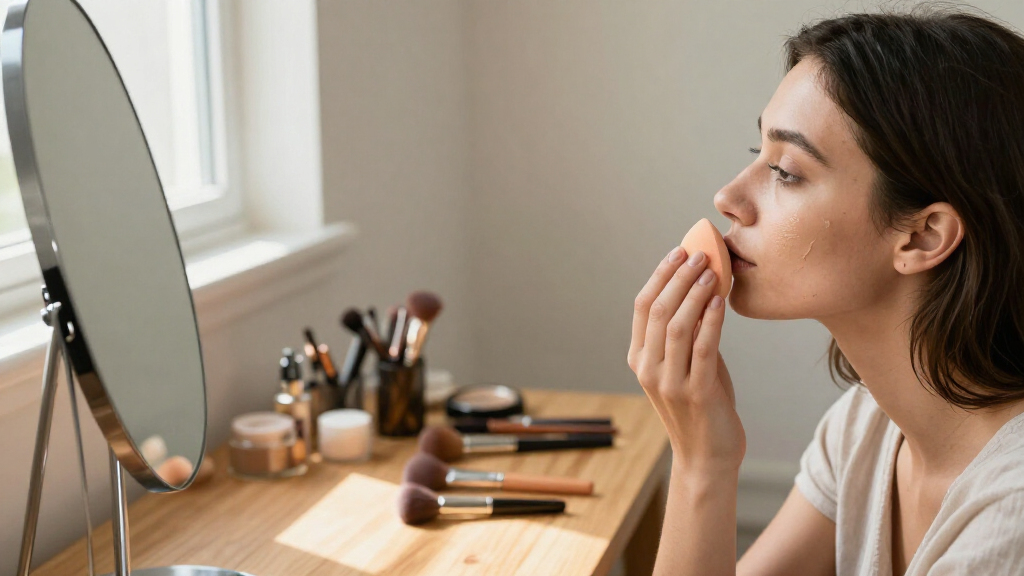
For the blending step, the sponge should be slightly damp, not saturated. Quinn’s instructions are to wet it, squeeze out excess water, and press it in a clean towel. The report says to use the rounded end to pick up product and tap or bounce it over the face, adding coverage gradually where wanted. Kasey Spickard, another New York-based celebrity makeup artist, recommends a bouncing or stippling motion to blend without lifting too much coverage. The pointed end can reach around the nose and beneath the eyes.
Christian Briceno, a New York-based celebrity makeup artist, says sponges let him work in thin layers, soften coverage differences and lift excess product without disturbing the rest of the makeup. The guide suggests using leftover product along the jawline and hairline, then adding concealer to areas needing fuller coverage. It describes setting powder and setting spray as finishing options, while cautioning that different areas of the face may need different amounts of foundation.
A More Controlled Foundation Finish
The method offers readers a way to adjust coverage instead of applying the same amount of foundation across the whole face. Starting with a small quantity and adding layers gradually may help avoid using more product than needed; that is the rationale given by the artists, not a measured comparison of results.
The distinction between placing foundation with a brush and blending it with a sponge is also useful for readers deciding how to use tools they already own. The guide presents the sponge as a way to soften edges and even out transitions, while noting that it may produce a more natural-looking finish rather than full coverage. Anyone seeking more coverage can build it selectively or use concealer, according to the report.
Popular right now

Roborock F25 GT Set Cordless Wet Dry Vacuum Cleaner and Mop with 2 Brushes

Ninja CREAMi Scoop & Swirl 13-in-1 Ice Cream and Soft Serve Maker, NC701

Vitamix Propel Series 750 Professional-Grade Blender, 4 Programs, Black
As an affiliate, we earn on qualifying purchases.
The Technique Behind the Advice
The report frames sponge application as an alternative to using fingers or relying on a compact’s thin applicator. It focuses on a well-structured makeup sponge, including beauty-blender-style tools and powder puffs, and distinguishes those from flimsy compact sponges. Its core advice is to keep the sponge clean and use it damp for blending.
The article’s experts describe the expected finish in subjective terms. Quinn says a sponge can help foundation look blended and less noticeable; Briceno describes the benefits of thin layers and softened transitions. These are attributed professional opinions in a beauty guide, not findings from a controlled test. The supplied source gives no publication date, product-testing details, or independent evidence comparing sponge application with other methods.
““What I particularly like about sponges is that they let me work with very thin layers, soften transitions between areas with more and less coverage, and gently lift excess product without disturbing the rest of the makeup.””
— Christian Briceno, celebrity makeup artist based in New York City
Results Depend on Skin and Product
The source does not establish that sponge application is more long-lasting than other techniques for all users. Its claims about a natural finish, reduced patchiness and wear are professional guidance and expectations, not results from a comparative study. The article also does not specify how performance varies by foundation formula, skin type, climate, or sponge material.
It is also unclear how often readers should wash or replace a sponge: the supplied excerpt says to start with a clean tool but gives no cleaning schedule. The guide does not report testing on mature skin or provide a universal rule for whether a sponge or brush is better. Those choices remain dependent on the desired coverage and individual preferences.
Try the Steps and Adjust Coverage
The source offers no announced follow-up, product trial, or study. Readers following the guide can start with a clean, slightly damp sponge and a small amount of foundation, then add coverage in targeted areas rather than applying a heavy layer at once. The article’s sequence ends with optional concealer and setting products.
Any assessment of whether the method suits a particular foundation or gives the desired wear would come from individual use; the supplied report provides no broader outcome data. Readers should follow care instructions for their sponge and makeup products, and stop using a tool or product if it causes irritation.
Key Questions
Should a makeup sponge be wet or dry?
The artists quoted in the Glamour UK guide recommend a slightly damp sponge for blending foundation. Wet it, squeeze out excess water, and press it in a clean towel; it should not be saturated. Quinn says a dry sponge can be useful for more concentrated coverage, but the guide favors damp use for a softer finish.
How should foundation be applied with a sponge?
Put a small amount on the back of your hand, dot it onto the centre of the face with a brush, then tap it into the skin with the rounded end of a clean, damp sponge. Work outward and build coverage gradually. The pointed end can reach smaller areas such as around the nose.
Does a sponge give full coverage?
The guide says sponge application tends to create a more natural-looking finish rather than full coverage. The artists recommend adding layers where needed and using concealer on areas that require more coverage.
Is applying foundation with a sponge better than using a brush?
The source does not establish that one tool is better for everyone. Its technique uses both: a brush places foundation, and a sponge taps and blends it. The preferred tool depends on the finish and coverage a person wants.
Source: glamourmagazine.co.uk