
TL;DR

Get beauty and skincare favorites delivered free — and shop member deals
- Fast, free delivery on millions of items
- Access to Prime Big Deal Days deals on October 6–7
- Prime Video, Amazon Music and more included
Premium styling devices can reduce some risks of heat damage with better tech, but your technique remains key. Using the right temperature, protective products, and proper handling helps keep hair healthy over time.
Every strand of your hair is a tiny, delicate fortress built of keratin, protected by a thin, resilient cuticle. When you wield a premium styling device set too hot or used improperly, it’s like an aggressive storm battering that fortress—moisture escapes, cuticles crack, and keratin weakens. The result? Dullness, brittleness, split ends, and a loss of that natural shine. But with smarter practices, you can enjoy sleek styles without sacrificing your hair’s health.
This guide reveals how to harness high-end styling tools safely, focusing on temperature control, correct technique, and essential protective measures. Whether you love a glossy blowout or perfectly curled locks, the goal is to keep your hair resilient and vibrant, no matter how advanced your tech.
Always start styling with the lowest effective temperature for your hair type.
Proper application of heat protectant can significantly cut down damage risk.
Use controlled, steady technique—small sections, smooth movement, avoiding prolonged contact.
Limit heat styling frequency to give your hair time to recover and stay healthy.
Maintain your tools well—clean and repair to ensure even, safe heat distribution.
How to Protect Your Hair from Heat Damage When Using Premium Styling Devices
Premium technology can deliver steadier temperatures, smoother contact and stronger airflow—but no hot tool is damage-proof. Healthy styling still depends on the temperature you choose, the time you expose each strand and the way you handle the tool.
Controlled, moderate heat paired with proper technique versus careless high-temperature styling, according to BellaPiu experts.
Damage risk rises rapidly above this approximate level, particularly for bleached, fragile or chemically treated hair.
“Think of your styling device as a fine instrument: tuned, clean and used with respect.”
The principle of safer stylingYour hair is a delicate keratin fortress
The visible hair shaft is protected by an overlapping outer cuticle. Too much heat drives out moisture, disrupts that protective surface and weakens the keratin structure beneath it. Because the shaft is not living tissue, cumulative damage cannot be permanently healed.
Dehydration
Excessive heat removes water from the shaft, leaving strands rougher, less flexible and more prone to snapping.
Cuticle erosion
Cuticle scales can lift, crack or wear away, reducing smoothness and exposing the vulnerable inner structure.
Keratin weakening
Repeated thermal stress changes the proteins that give hair its strength, shape and natural resilience.
Internal bubbles
Very wet hair heated too quickly can develop bubbles and fractures inside the shaft before damage is visible.
Color and shine loss
A roughened surface reflects less light, while repeated high heat can accelerate fading in colored hair.
Breakage and split ends
Reduced elasticity increases tangling, brittleness and breakage—even when the strand initially looks intact.
Damage can build before you see it.
Conditioners and bond-building formulas can improve feel, appearance and resistance to further stress. They cannot make a severely damaged section biologically new again.
Start low. Increase only when the result demands it.
These temperature bands are approximate starting points, not universal rules. Hair condition matters as much as texture. Test a lower setting first, use a controlled pass and assess the cooled section before adding more heat.
The safe method changes with the device
Premium controls improve consistency, but the tool must still match the hair’s moisture level. Conventional irons belong on fully dry hair; purpose-built airflow and wet-to-dry systems require their own manufacturer-directed technique.
| Styling situation | Best practice | Risk signal | Verdict |
|---|---|---|---|
| Conventional flat iron on fully dry, protected hair | Small sections, steady motion and the lowest effective heat | Repeated passes or clamping in one place | ✓Appropriate |
| Conventional curling iron on damp or wet hair | Dry the hair completely before contact | Sizzling, visible steam or rapid moisture loss | ✗Avoid |
| Purpose-built wet-to-dry or airflow device | Follow device instructions and stop treating sections once dry | Repeatedly reheating already-dry areas | ~Conditional |
| Ordinary oil applied before high-temperature ironing | Use only a product specifically labeled for heat styling | Unknown heat tolerance or an oily, uneven coating | ✗Avoid |
| Well-maintained premium device with even heat | Clean surfaces, inspect damage and repair faulty controls | Residue, snagging, temperature spikes or damaged plates | ✓Preferred |
Heat protectant is a safety net—not a free pass
A well-formulated protectant can create a thin film that improves heat distribution, reduces friction and slows moisture loss. The benefit depends on choosing the right formula and covering the hair evenly.
Apply the labeled amount
Too little may leave gaps; excessive product may create buildup. Follow the formula’s directions rather than guessing.
Distribute it everywhere
Comb through the ends, underside and inner sections. Uneven coverage creates vulnerable hotspots.
Match product to tool
Select a formula designed for the device and temperature involved, whether blow-drying, curling or straightening.
Allow wet formulas to dry
Sprays and creams should dry before a conventional iron touches the hair, preventing rapid steam formation.
Layer with purpose
A protectant may be used before blow-drying and an appropriate dry-hair formula before ironing when labels permit.
Protection has limits
No formula makes unlimited heat safe. Temperature and technique remain the primary controls.
Five moves from preparation to polished finish
Good technique reduces total exposure. Work deliberately, let the tool’s engineering do its job and avoid chasing perfection with repeated passes.
Detangle
Remove knots first so the tool can glide without snagging or concentrated friction.
Section
Use small, manageable sections that allow even contact and efficient styling.
Set low
Begin at the lowest temperature likely to work for the hair’s condition and texture.
Move steadily
Avoid prolonged clamping. Use one smooth, controlled pass whenever possible.
Cool and assess
Let the section cool before deciding whether it genuinely needs another pass.
Every protective choice supports the next
Healthy styling is not one product or one premium feature. It is a connected system that controls moisture, temperature, friction, exposure time and recovery.
Premium styling, practiced responsibly
Better technology can reduce unnecessary exposure, but technique determines whether those advantages translate into healthier hair over time.
Why Heat Damage Happens — The Hidden Cost of Hot Tools
Heat damage occurs when high temperatures strip moisture from your hair and erode its outer layer—the cuticle. Think of the cuticle like a glossy, protective fence. When it lifts or cracks, your hair becomes more vulnerable to breakage and dullness. Excessive heat also weakens keratin proteins inside, making strands more brittle and prone to split ends.
Understanding why this matters is crucial because the damage isn’t always immediately visible. Over time, repeated heat exposure can cause cumulative weakening, leading to a loss of natural elasticity and shine. This means that even if your hair looks okay after styling, underlying damage might be silently building up, making your hair more fragile and less resilient to everyday stressors. Recognizing the importance of limiting heat exposure helps you make smarter choices that preserve your hair’s integrity in the long run.
Research shows that repeated heat exposure elevates the risk of internal bubbles forming in the hair shaft, especially when applied to damp hair, leading to internal fractures and fractures that are invisible until breakage occurs.
As an affiliate, we earn on qualifying purchases.
Set Your Heat to the Right Level — When Less Is More
Starting with the lowest effective temperature is the simplest way to protect your hair. Using a high setting won’t guarantee better results but will significantly increase damage risk. The core idea is that more heat doesn’t mean better styling—it often leads to unnecessary stress on your strands, accelerating damage and reducing the longevity of your style.
Choosing the right temperature isn’t just about avoiding damage; it’s about balancing efficacy with health. For instance, fine or chemically processed hair can be styled effectively at lower temperatures, which helps maintain the integrity of weakened strands. Conversely, thicker or resistant hair may require slightly higher heat but still benefits from moderation. The tradeoff is clear: higher temperatures may provide faster results or more curl, but at the cost of increased damage and reduced hair health over time. Therefore, understanding your hair type and sticking to the minimal effective temperature helps you achieve your desired style without sacrificing your hair’s future.
Research from BellaPiu indicates that temperatures above 200°C dramatically increase the chance of damage, especially if you go over the same section multiple times. It’s about quality, not quantity—one controlled pass at a moderate temperature often beats multiple passes at high heat.
Remember: You’re better off gradually increasing temperature only if necessary, not habitually defaulting to maximum heat.
professional hair straightener with temperature control
As an affiliate, we earn on qualifying purchases.
As an affiliate, we earn on qualifying purchases.
Master the Art of Using Heat Protectant — Your First Line of Defense
Heat protectants are your best friends—forming a thin, invisible shield that disperses heat and reduces moisture loss. But they are not magic shields—proper application matters. Using a protectant incorrectly or unevenly can leave parts of your hair vulnerable, creating weak spots where damage can initiate.
Applying a generous, even layer on damp or dry hair ensures that each strand is uniformly coated, which is vital because uneven coverage can lead to hotspots where heat causes more damage. Letting sprays or creams dry thoroughly before applying heat allows the product to form a stable barrier, optimizing its protective effect. Products with silicones, conditioning polymers, and hydrolyzed proteins tend to work best because they create a durable film that withstands high temperatures and helps maintain moisture balance.
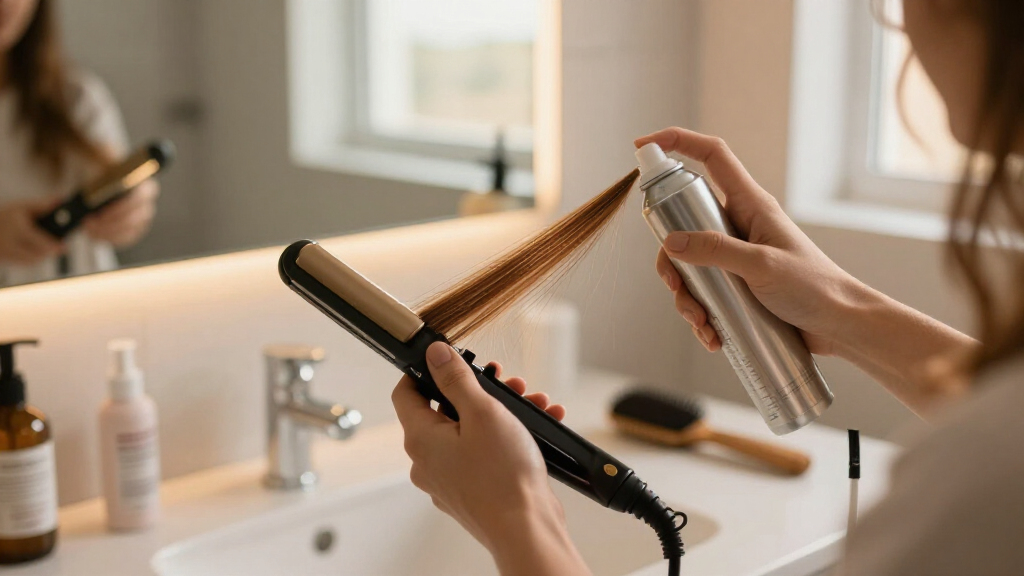
For example, BellaPiu recommends spraying a heat protectant on damp hair before blow-drying and again on dry hair before flat ironing. This layered approach enhances protection without adding weight or greasiness. Proper application ensures that the heat is evenly distributed and that the product’s benefits are maximized, reducing the risk of hotspots or uneven heating that can cause damage.
Remember: Protectant use is essential, but it cannot fully compensate for high heat or poor technique. Think of it as a crucial first step—your safety net, not a free pass to crank up the heat.
heat-resistant hair styling gloves
As an affiliate, we earn on qualifying purchases.
As an affiliate, we earn on qualifying purchases.
Conclusion
Protecting your hair from heat damage isn’t about avoiding hot tools altogether. It’s about smart, mindful use—balancing the power of premium technology with careful handling. Your hair’s health depends on it.
Think of your styling device as a fine instrument—tuned, clean, and used with respect. That way, your hair stays radiant, resilient, and ready for whatever style you desire, day after day.
As an affiliate, we earn on qualifying purchases.
Fall Picks
fall essentials
As an affiliate, we earn on qualifying purchases.